Introduction: Why Customer Intelligence Pipelines Matter
In modern ecommerce, data is everywhere—but insight is rare. Businesses collect massive amounts of data from platforms like WooCommerce, Google Analytics 4, advertising networks, CRMs, and payment gateways. Yet despite this abundance, most ecommerce businesses struggle to answer simple questions like: Who are our most valuable customers? Where do they come from? What drives repeat purchases?
The problem is not a lack of data. The problem is the absence of a well-designed customer intelligence pipeline. Without a structured system that collects, processes, and unifies customer data, businesses are left with fragmented reports, conflicting metrics, and decisions based on incomplete information.
In this article, we will break down how to design a scalable, reliable, and actionable customer intelligence pipeline for ecommerce, focusing on real-world architecture, data flows, and implementation strategies.
What Is a Customer Intelligence Pipeline?
A customer intelligence pipeline is a system that transforms raw customer data into actionable insights. It connects multiple data sources, processes the data into a unified structure, and enables analytics, reporting, and decision-making.
- Data collection from multiple sources
- Data transformation and cleaning
- Data storage in a centralized system
- Data modeling for analysis
- Insight generation (dashboards, reports, AI)
Unlike traditional analytics setups, a customer intelligence pipeline is not tool-dependent. It is architecture-driven.
The Core Problem: Fragmented Customer Data
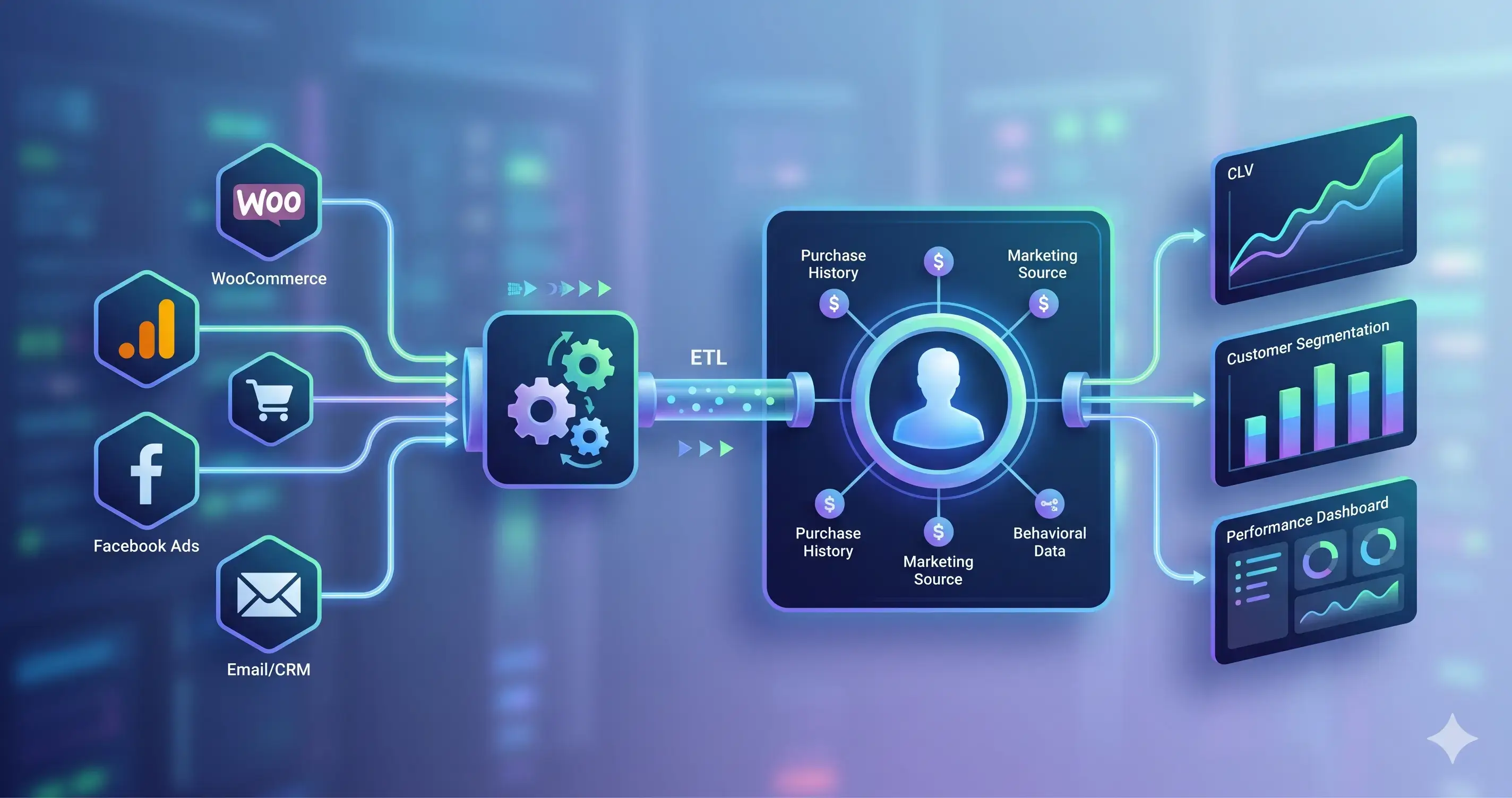
Most ecommerce stores operate with disconnected systems:
- WooCommerce stores orders
- Google Analytics tracks sessions
- Facebook Ads tracks campaigns
- Email platforms track engagement
Each system tells a different story. None of them provide a complete view of the customer journey.
This leads to common issues:
- Inconsistent attribution data
- Duplicate customer records
- Incorrect lifetime value calculations
- Disconnected marketing insights
A customer data pipeline solves this by unifying data at the customer level.
Architecture Overview: How the Pipeline Works
A well-designed ecommerce data pipeline consists of the following layers:
- Data Sources
- Ingestion Layer
- Transformation Layer (ETL/ELT)
- Data Storage (Warehouse)
- Analytics & Visualization
1. Data Sources
These include WooCommerce, payment providers, analytics tools, and marketing platforms. Each source provides partial customer data.
2. Ingestion Layer
Data is extracted using APIs, webhooks, or batch jobs. This layer ensures data is consistently pulled into your system.
3. Transformation Layer
This is where raw data becomes usable. Data is cleaned, normalized, and joined into unified customer profiles.
4. Data Storage
A centralized database (e.g., PostgreSQL, BigQuery) stores structured data for analysis.
5. Analytics Layer
Dashboards and reports are built on top of the data warehouse to generate insights.
Pipeline Flow (Conceptual)
Data Sources → Ingestion → Transformation → Warehouse → Analytics
This linear flow represents how raw data moves through your system until it becomes actionable insight.
Step-by-Step: Designing Your Pipeline
Step 1: Define the Customer Model
Before writing any code, define what a “customer” means in your system. This includes:
- Unique identifiers (email, user ID)
- Order history
- Acquisition source
- Behavioral data
This step is critical for accurate customer segmentation and customer lifetime value (LTV) calculations.
Step 2: Build Data Ingestion
Use APIs and scheduled jobs to fetch data. For WooCommerce, this includes orders, customers, and products.
Key considerations:
- Rate limits
- Incremental sync (only fetch changes)
- Error handling
Step 3: Normalize the Data
Raw data is messy. Normalize fields like currency, timestamps, and identifiers.
Example:
email -> lowercase
currency -> unified format
dates -> UTC
Step 4: Build the Customer View
Merge data into a single customer profile. This includes orders, sessions, and marketing data.
This is the core of your customer intelligence system.
Step 5: Create Analytical Models
Build derived metrics such as:
- Customer lifetime value
- Purchase frequency
- Churn probability
- RFM segmentation
Step 6: Deliver Insights
Use dashboards or APIs to expose insights to stakeholders.
Common Mistakes in Customer Intelligence Pipelines
- Relying only on GA4 data
- Not handling duplicate customers
- Ignoring data quality issues
- Overengineering too early
A good pipeline is simple, reliable, and scalable.
Tools and Technologies
A typical stack for a customer intelligence pipeline includes:
- Python (data processing)
- FastAPI (APIs)
- PostgreSQL or BigQuery (data warehouse)
- Airflow or cron jobs (scheduling)
- Metabase or Looker (visualization)
The exact tools matter less than the architecture.
From Data to Decisions
The ultimate goal of a customer intelligence pipeline is not dashboards—it is better decisions.
When designed correctly, your pipeline enables:
- Better marketing targeting
- Improved retention strategies
- Accurate revenue forecasting
- Data-driven product decisions
FAQ (Customer Intelligence Pipeline)
What is a customer intelligence pipeline?
A customer intelligence pipeline is a structured system that collects, processes, and unifies customer data from multiple sources to generate actionable insights for ecommerce businesses.
Why is a customer data pipeline important for ecommerce?
Because ecommerce data is fragmented across platforms (WooCommerce, GA4, ads, CRM), a pipeline ensures a single source of truth, enabling accurate decision-making and reliable analytics.
How is a customer intelligence pipeline different from analytics tools?
Analytics tools visualize data, while a customer intelligence pipeline structures, cleans, and unifies it. The pipeline is the foundation; dashboards are just the output layer.
What technologies are used in a customer intelligence pipeline?
Common technologies include Python, FastAPI, PostgreSQL or BigQuery, ETL tools, and BI platforms like Metabase or Looker.
How do you calculate customer lifetime value (LTV)?
Customer lifetime value is calculated by aggregating total revenue generated by a customer over time, often combined with predictive modeling for future behavior.
Conclusion
Designing a customer intelligence pipeline is not about installing tools—it is about building systems.
In a world where data is abundant but insight is scarce, the businesses that win are the ones that can turn raw data into clear, reliable, and actionable intelligence.
If you are serious about ecommerce growth, investing in a proper customer data architecture is not optional—it is a competitive advantage.