Case Study: Onymia
A modular internal system combining client ticketing, financial management, and AI-powered support — built to reduce manual overhead and give clients structured, real-time visibility into their service relationship with Onymia.
Context: The problem with growing on informal systems
As Onymia grew its client base across web development, e-commerce, and data services, the agency’s operational backbone remained largely informal — requests arrived through chat threads, invoices were tracked in spreadsheets, and clients had no clear window into their service history or budget status.
This created friction on both sides. Clients couldn’t easily follow the progress of their requests, and internally, the team spent disproportionate time on administrative coordination rather than delivery. The platform was designed to eliminate this overhead entirely.
Solution: Three systems. One platform.
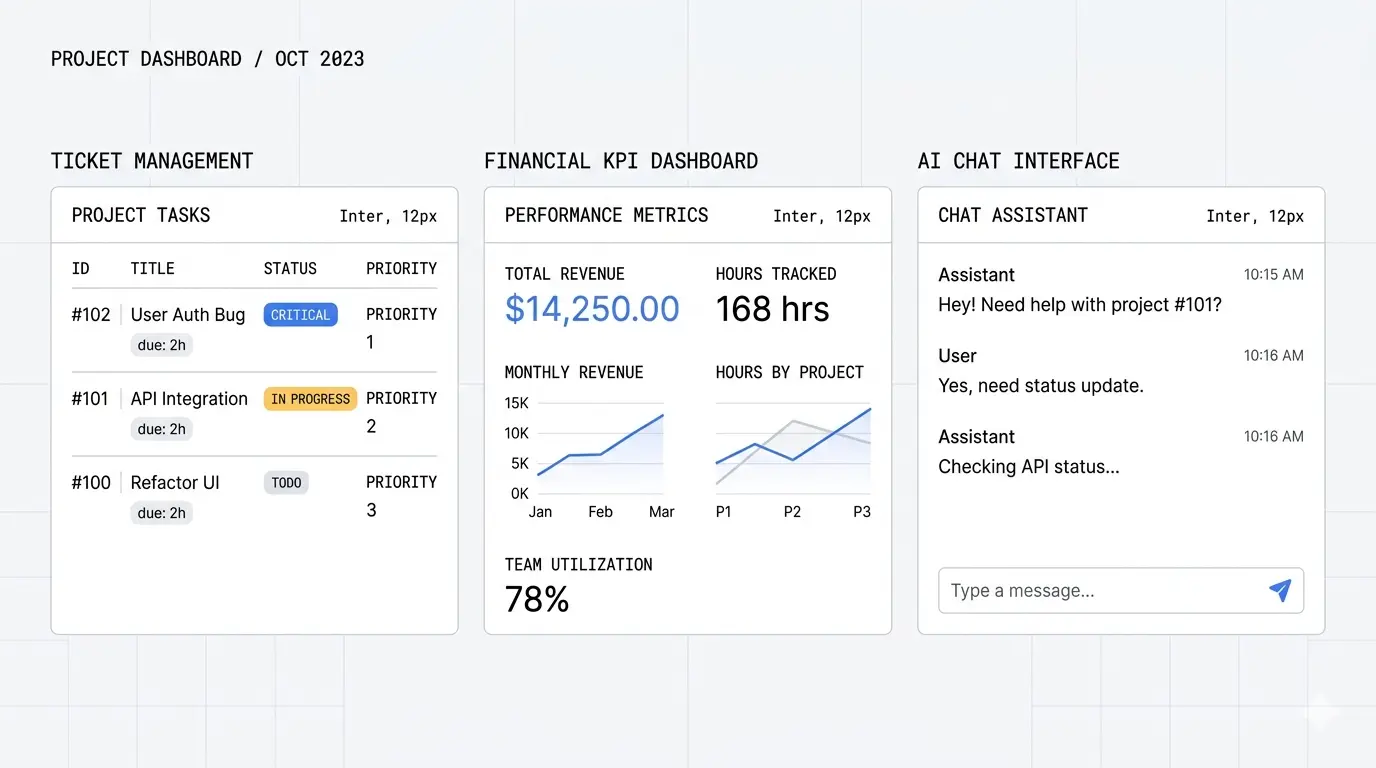
The Partner Platform was built as a modular system with three tightly integrated pillars, each solving a distinct pain point in the client-agency relationship.
01 — Ticketing System
Centralizes all client requests in one place. Role-based access ensures that clients see only their own tickets, while admins have full visibility across accounts. Automated email notifications keep all parties informed at every status change, and a progress-tracking interface replaces the guesswork of chat-based communication.
02 — Financial Management & Dashboard
Tracks support hours, invoices, and key performance indicators in real time. Clients can log in and see exactly how their budget is being used — hours consumed, services rendered, and upcoming billing. Admins get a consolidated financial view across all accounts, making reporting and invoicing dramatically faster.
03 — AI Chatbot
Integrated directly with Onymia’s internal knowledge base, the chatbot handles the most common client questions instantly — from onboarding guidance and service explanations to process clarifications and day-to-day operational queries. It reduces repetitive support load and provides a consistent, always-available first line of response.
Design Approach: Built for two audiences simultaneously
The platform serves two distinct user types with fundamentally different needs: clients who want clarity and transparency, and admins who need operational control and efficiency. Every interface decision was made with this dual context in mind.
Role-based access control separates the two experiences cleanly. A client logging in sees their own tickets, their own financial summary, and has access to the AI assistant. An admin sees the full picture — all accounts, all tickets, aggregate financials — without the noise of unrelated client data bleeding through.
The financial dashboard was designed to be self-explanatory. Clients should be able to understand their service relationship with Onymia without needing to ask for a report or wait for a monthly update. Real-time visibility builds trust and significantly reduces the volume of status-check messages that would otherwise arrive through informal channels.
Impact: Structured operations, measurable results
↓ Admin overhead — Less time spent on manual coordination and status updates.
↑ Client trust — Real-time financial visibility for clients across all engagements.
24/7 availability — AI-powered first-line support without manual intervention.
Beyond the direct efficiency gains, the platform established a scalable foundation for Onymia’s client relationships. Instead of operational processes being implicit and person-dependent, they became encoded in the system — auditable, consistent, and ready to grow with the agency.
The goal was never just a tool. It was building the infrastructure that lets Onymia operate like a product company, not a services shop.
Technical Stack
Python · Django · PostgreSQL · REST API · Role-based Access Control · AI / LLM Integration · Knowledge Base RAG · Automated Email Notifications · Financial Dashboard · Modular Architecture